Why Deduction Management Is So Challenging

Deduction management is rarely a single-system or single-department process.

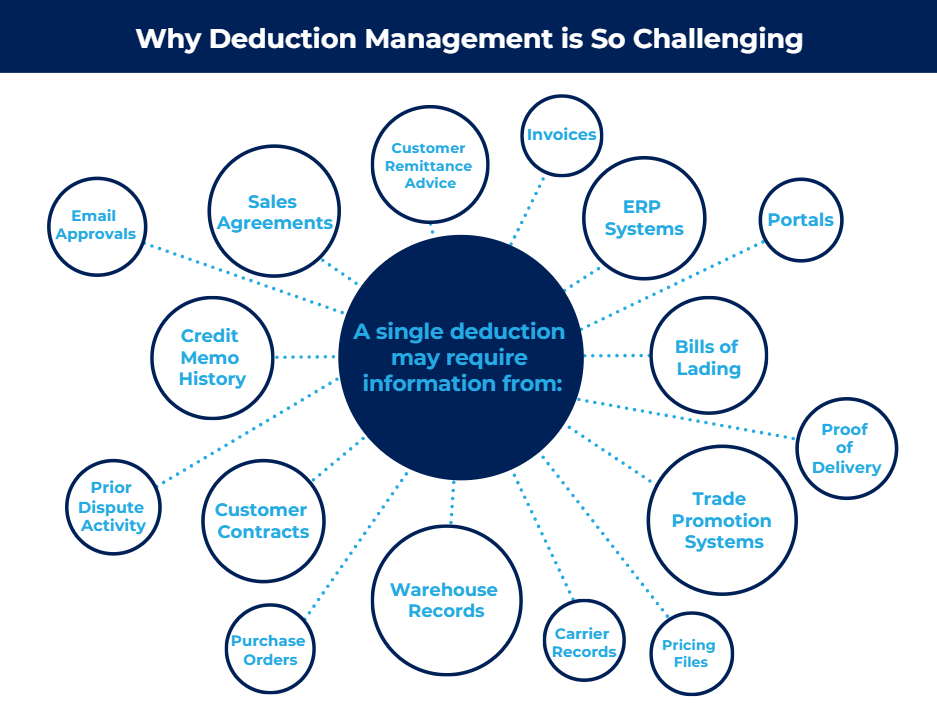
A single deduction may require information from:

  • Customer remittance advice
  • Retailer or customer portals
  • ERP systems
  • Trade promotion systems
  • Pricing files
  • Customer contracts
  • Sales agreements
  • Purchase orders
  • Invoices
  • Bills of lading
  • Proof of delivery
  • Warehouse records
  • Carrier records
  • Credit memo history
  • Email approvals
  • Prior dispute activity
Infographic titled “Why Deduction Management is So Challenging” showing that a single deduction may require information from many different sources, including sales agreements, customer contracts, ERP systems, trade promotion systems, portals, invoices, proof of delivery, bills of lading, warehouse records, pricing files, carrier records, purchase orders, prior dispute activity, credit memo history, email approvals, and customer remittance advice. A central circle connects to each information source, illustrating the complexity of researching and resolving deductions.

Common challenges include:

  • High deduction volume
  • Short dispute windows
  • Missing or incomplete backup
  • Multiple portals and customer systems
  • Inconsistent customer reason codes
  • Manual document retrieval
  • Disconnected internal systems
  • Incomplete ERP data
  • Limited staff capacity
  • Unclear ownership across departments
  • Delayed dispute follow-up
  • Limited root cause reporting
  • Recurring deductions that are not prevented

Deduction research becomes even more complex when multiple deductions are tied to the same invoice, purchase order, shipment, agreement, or claim event. A shortage, damage claim, compliance fine, pricing deduction, or trade deduction may all relate to the same underlying transaction. Reviewing each deduction separately can miss duplicate, overlapping, excessive, or already-compensated claims.

IAB Insight: Many companies evaluate deductions one claim at a time. Our experience shows that reviewing all deductions associated with the same invoice, purchase order, shipment, promotion, or customer event often uncovers duplicate deductions, overlapping claims, prior credits, and excessive recovery attempts that may otherwise go unnoticed. Looking at related deductions collectively frequently improves recovery outcomes and strengthens root cause identification.

Key Point: Deduction management is difficult because it requires both customer-facing research and internal reconciliation. The customer’s claim tells part of the story. ERP, shipment, pricing, trade, and credit history complete the picture.

Download our free, comprehensive Deduction Management Guide

Enter your email below to access 50+ pages of practical insights, best practices, recovery strategies, technology considerations, KPIs, and checklists for building a more effective deduction management program.

Get Started

Work with our professional, experienced and stable management team to fill your accounts receivable outsourcing needs.