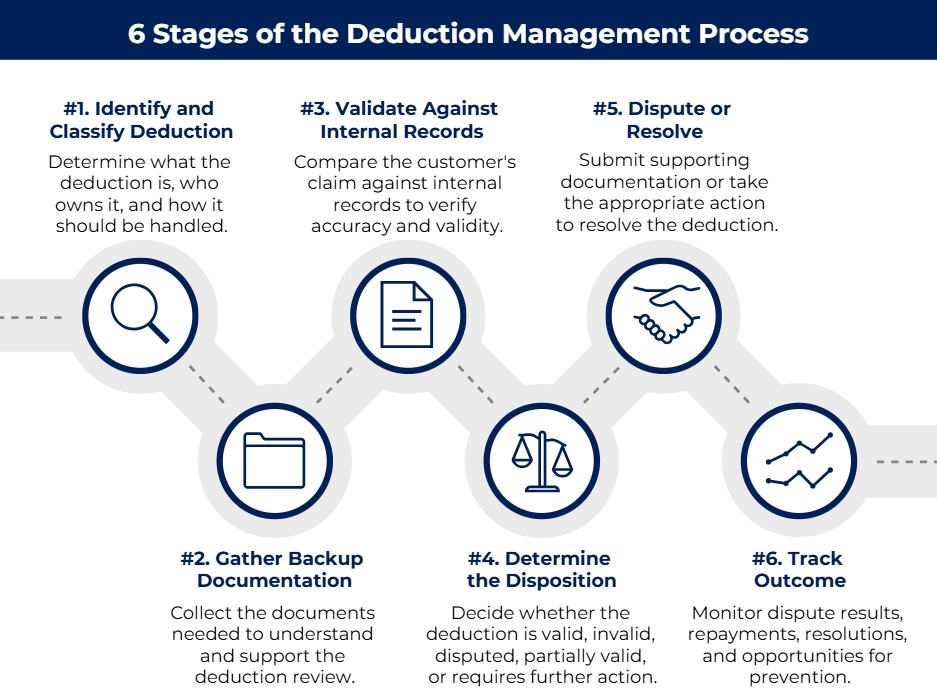
The Deduction Research Process

A strong deduction management process follows a consistent research framework. While specific steps vary by customer and deduction type, the core process is similar.

Proactive Step: Monitor Pending Claims

Deduction management does not always begin after a deduction occurs. Many portals provide visibility to certain claims before the deduction is actually taken.

This is particularly relevant for:

  • Compliance claims
  • Damage claims
  • Shortage claims
  • Operational chargebacks
  • Certain retailer-generated penalties

By monitoring pending claim activity, deduction teams can:

  • Identify potential deductions before they hit A/R
  • Retrieve documentation earlier
  • Review claim details sooner
  • Alert Logistics, Compliance, Transportation, Sales, or Customer Service
  • Prepare dispute support in advance
  • Reduce the time between deduction and dispute submission
  • Improve visibility into recurring operational issues

Step 1: Identify and Classify the Deduction

Key data points include:

  • Customer name
  • Deduction date
  • Payment date
  • Invoice number
  • Purchase order number
  • Claim number
  • Deduction amount
  • Deduction code
  • Customer reason description
  • Deduction category
  • Responsible owner
  • Dispute deadline, if applicable

Accurate classification supports prioritization, workflow, reporting, and root cause analysis.

Step 2: Gather Backup Documentation

Common backup includes:

  • Remittance advice
  • Customer claim backup
  • Portal documentation
  • Original invoice
  • Purchase order
  • Bill of lading
  • Proof of delivery
  • Carrier documentation
  • Warehouse shipment detail
  • Customer receiving records
  • Pricing agreement
  • Trade promotion agreement
  • Deduction notice
  • Credit memo history
  • Email approvals
  • Prior dispute responses

Missing backup does not automatically make a deduction invalid, but it does mean additional research is needed.

Step 3: Validate Against Internal Records

The deduction should be compared against internal records.

Key questions include:

  • Was the invoice billed correctly?
  • Was the deduction taken against the correct invoice?
  • Was the product shipped in full?
  • Was the shipment delivered on time?
  • Was there documented damage or shortage?
  • Was pricing aligned with the customer agreement?
  • Was the promotion valid and approved?
  • Was a credit already issued?
  • Was the deduction previously repaid or denied?
  • Is the claim a duplicate?
  • Is the claim partially valid?

Important Distinction: Pulling claim data is not the same as validating a deduction. Validation requires reconciliation against internal records.

Step 3A: Review Related Deductions Holistically

Deduction research should not always be limited to one deduction at a time. A single deduction may appear valid when reviewed on its own, but the conclusion may change when all deductions related to the same invoice, purchase order, shipment, promotion, agreement, delivery, or claim period are reviewed together.

For example, one invoice or purchase order may have multiple deductions tied to it, such as:

  • Shortage deduction
  • Pricing deduction
  • Compliance penalty
  • Damage claim
  • Freight or routing deduction
  • Trade promotion deduction
  • Unsaleables or return-related deduction

 Individually, each deduction may appear to have some support. But when reviewed together, the total deducted amount may be excessive, duplicative, inconsistent, or unsupported.

A holistic review helps identify whether:

  • Multiple deductions were taken for the same issue
  • A customer deducted more than the value of the affected goods
  • A shortage claim overlaps with a damage or unsaleables claim
  • A pricing deduction duplicates an existing trade allowance or credit
  • A compliance fine was applied in addition to another related penalty
  • A deduction was already covered by an allowance, credit memo, or agreement
  • Claims are tied to the wrong invoice, PO, shipment, or agreement
  • The total deduction amount exceeds what the documentation supports

Key Point: A deduction may look valid in isolation, but the full claim picture may reveal duplicate, overlapping, excessive, or unsupported deductions.

Example: Why Holistic Review Matters

A customer may deduct against the same purchase order for:

  • A shortage claim because fewer goods were received
  • A damage claim for product allegedly received in poor condition
  • A compliance penalty for delivery or ASN issues
  • A pricing deduction tied to the same invoice

If each claim is reviewed separately, some may appear reasonable. But when reviewed together, the total deduction may exceed the value of the shipment issue, duplicate another claim, or include charges already covered by an allowance or prior credit. This is why deduction validation should include both line-item review and relationship review across related deductions.

Step 4: Determine the Disposition

Common dispositions include:

  • Valid deduction
  • Invalid deduction
  • Partially valid deduction
  • Duplicate deduction
  • Unsupported deduction
  • Requires additional documentation
  • Ready to dispute
  • Approved for write-off

Step 5: Dispute or Resolve

A strong dispute package should include:

  • Claim number
  • Invoice number
  • Deduction amount
  • Amount being disputed
  • Clear dispute reason
  • Concise explanation
  • Supporting documentation
  • Requested repayment amount
  • Submission date
  • Contact information

The dispute should be factual, organized, and easy for the customer to review.

Step 6: Track Outcome

Important tracking fields include:

  • Dispute submission date
  • Dispute case number
  • Submission method
  • Amount disputed
  • Amount approved
  • Amount denied
  • Amount repaid
  • Repayment date
  • Denial reason
  • Follow-up date
  • Escalation status
  • Final resolution
  • Root cause
  • Prevention opportunities
Infographic titled “6 Stages of the Deduction Management Process” illustrating a six-step workflow: (1) Identify and Classify Deduction, (2) Gather Backup Documentation, (3) Validate Against Internal Records, (4) Determine the Disposition, (5) Dispute or Resolve, and (6) Track Outcome. Each stage is represented by an icon and connected along a process path, showing how deductions move from initial review through resolution and ongoing monitoring.

Download our free, comprehensive Deduction Management Guide

Enter your email below to access 50+ pages of practical insights, best practices, recovery strategies, technology considerations, KPIs, and checklists for building a more effective deduction management program.

Get Started

Work with our professional, experienced and stable management team to fill your accounts receivable outsourcing needs.