Deduction Management Checklist

Strong deduction programs rely on disciplined routines. While responsibilities may vary by organization, the following activities provide a practical framework for managing deductions, accelerating recovery, and identifying opportunities for prevention.

Daily / Weekly Activities

  • Review new deductions
  • Monitor pending claims in portals
  • Code and classify new activity
  • Retrieve available backup
  • Prioritize high-dollar deductions
  • Identify time-sensitive claims
  • Assign research ownership
  • Validate against internal records
  • Prepare dispute packages
  • Submit disputes
  • Track customer responses
  • Follow up on open disputes

Monthly Activities

  • Review open deduction aging
  • Analyze recovery activity
  • Review dispute denials
  • Identify top deduction customers
  • Identify top deduction categories
  • Review pending claim trends
  • Review aged unresolved claims
  • Escalate high-dollar items
  • Share trends with cross-functional teams
  • Update root cause reporting
  • Review write-off activity

Quarterly Activities

  • Conduct root cause review
  • Review compliance trends
  • Update customer-specific requirements
  • Evaluate dispute success rates
  • Review staffing and workload
  • Assess automation opportunities
  • Identify process gaps
  • Share prevention recommendations
  • Review recovery performance against goals
  • Consider closed deduction or Safety Net Review opportunities

IAB Insight: Deduction recovery is often won or lost through process discipline.

Organizations that consistently review new deductions, follow up on disputes, monitor aging, and escalate issues before deadlines are typically more successful than those that focus only on large individual claims. Consistent execution helps prevent recoverable deductions from turning into avoidable write-offs.

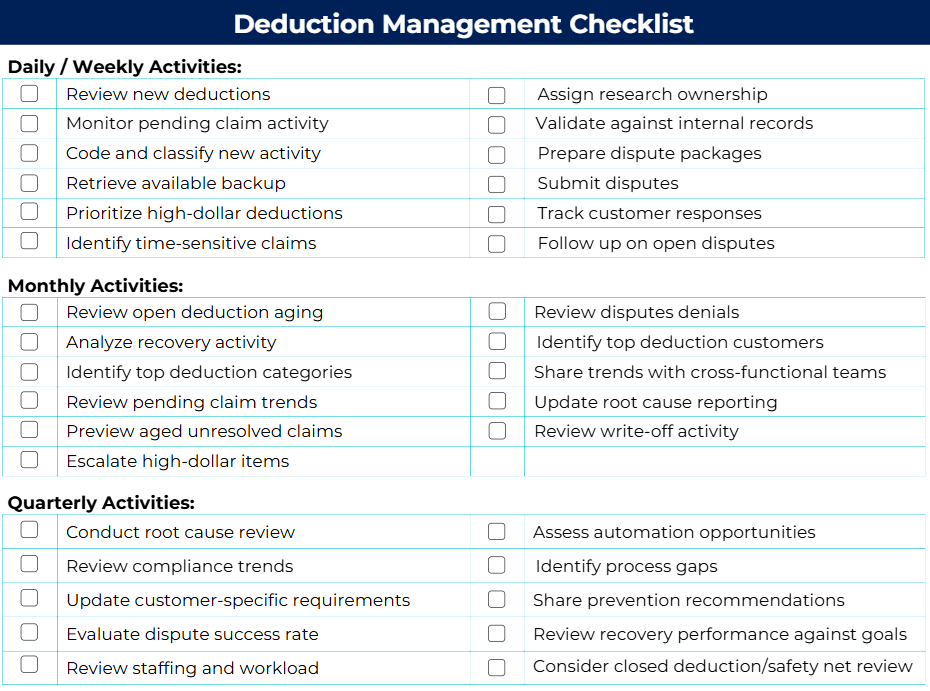
Infographic titled “Deduction Management Checklist” providing a structured list of deduction management activities organized by frequency: daily/weekly, monthly, and quarterly. Tasks include reviewing and classifying deductions, gathering backup documentation, submitting and tracking disputes, monitoring aging and recovery trends, analyzing root causes, reviewing write-offs and dispute outcomes, assessing automation opportunities, and identifying process improvements to strengthen deduction recovery and prevention efforts.

Download our free, comprehensive Deduction Management Guide

Enter your email below to access 50+ pages of practical insights, best practices, recovery strategies, technology considerations, KPIs, and checklists for building a more effective deduction management program.

Get Started

Work with our professional, experienced and stable management team to fill your accounts receivable outsourcing needs.