Retailer and Customer Portals: The Good, the Bad, and the Complicated

Retailer and customer portals are now central to deduction management. They may provide claim detail, backup documentation, dispute tools, repayment status, and communication history.

However, portals also create complexity because each customer may use different systems, rules, claim codes, documentation requirements, and dispute workflows.

The Good

Portals can help companies:

  • Access claim backup
  • Retrieve deduction details
  • Download supporting documentation
  • Submit disputes
  • Track claim status
  • View repayment decisions
  • Monitor deduction history
  • Identify customer-specific activity
  • View certain pending claims before deduction


The Bad

Common challenges include:

  • Multiple login credentials
  • User access limitations
  • Inconsistent navigation
  • Missing backup
  • Limited export capabilities
  • Manual downloads
  • File naming issues
  • Time-consuming document retrieval
  • Portal outages
  • Workflow changes
  • Limited visibility into dispute status


The Complicated

Portal data still needs to be reconciled against internal company data. A portal may show the customer’s claim, but the supplier still needs to determine:

  • Is the claim valid?
  • Does it match the invoice?
  • Does the backup support the amount deducted?
  • Was the shipment complete?
  • Was the pricing correct?
  • Was the deduction previously resolved?
  • Is the claim a duplicate?
  • Is additional documentation needed?
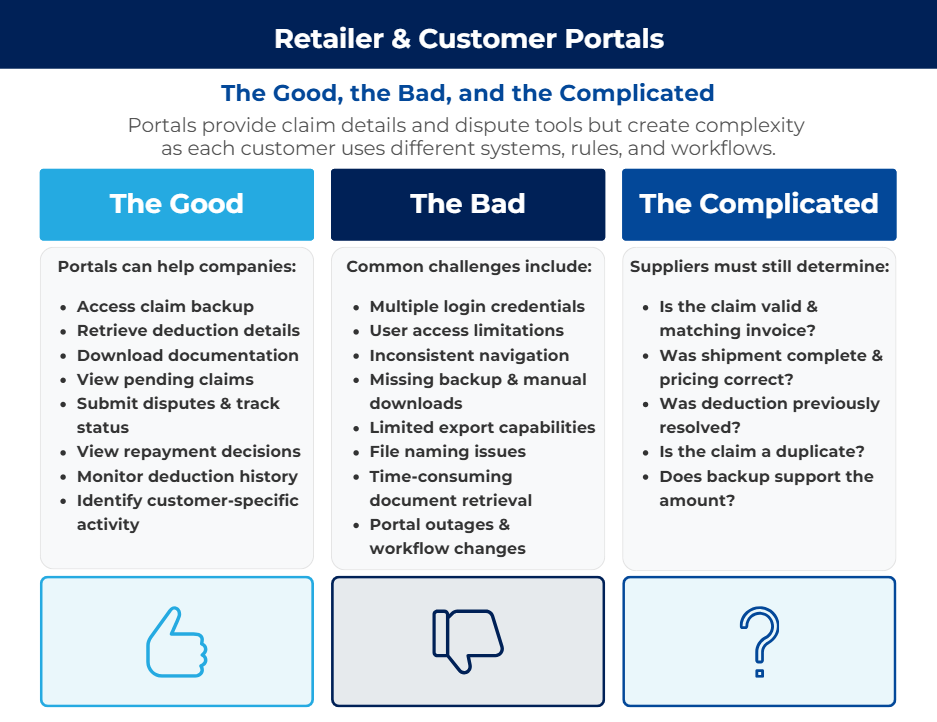
Infographic titled “Retailer & Customer Portals: The Good, the Bad, and the Complicated.” The graphic compares the benefits and challenges of retailer portals. The “Good” section highlights access to claim details, documentation, disputes, and deduction history. The “Bad” section outlines challenges such as multiple logins, navigation issues, missing backup, and workflow changes. The “Complicated” section emphasizes that suppliers must still determine claim validity, pricing accuracy, duplicate claims, and whether supporting documentation justifies the deduction. Icons of a thumbs up, thumbs down, and question mark visually represent each category.

Important Distinction: Portals provide information. They do not replace research, reconciliation, judgment, or follow-up.

Download our free, comprehensive Deduction Management Guide

Enter your email below to access 50+ pages of practical insights, best practices, recovery strategies, technology considerations, KPIs, and checklists for building a more effective deduction management program.

Get Started

Work with our professional, experienced and stable management team to fill your accounts receivable outsourcing needs.