What Is Deduction Management?

Deduction management is the process of identifying, researching, validating, resolving, recovering, and preventing customer deductions.

A deduction occurs when a customer reduces the amount paid to a supplier or takes a separate claim against the supplier’s account. While deductions are often associated with open invoices, they are not always a direct short payment of a specific invoice.

In many cases, customer invoices are paid in full, and the deduction appears as a separate line item on the remittance. That deduction may refer to an invoice number, purchase order number, claim number, agreement number, promotion number, or other customer-generated references.

For example, shortage and pricing deductions often refer to a supplier invoice. In contrast, trade promotion, compliance, damage, freight, or post-audit deductions may refer to a purchase order, customer claim, shipment, promotional agreement, routing event, or other transaction details.

There are also situations where a customer short-pays an invoice without clearly explaining the reason on the remittance. In those cases, the supplier may need to research the customer portal, claim backup, payment details, or other supporting documentation to determine why the invoice was not paid in full.

Deductions may be taken for many reasons, including:

  • Shortages
  • Damages
  • Pricing discrepancies
  • Promotional allowances
  • Trade agreements
  • Compliance violations
  • Freight issues
  • Returns or unsaleables
  • Post-audit claims
  • Duplicate credits or prior activity
  • Other customer-generated adjustments

Some deductions are planned, valid, and properly supported. Others may be invalid, duplicated, incorrectly calculated, unsupported, referenced incorrectly, or deducted without sufficient explanation.

Without a structured deduction management process, companies may experience:

  • Increased write-offs
  • Missed recovery opportunities
  • Aging deduction backlogs
  • Delayed dispute submissions
  • Limited visibility into customer trends
  • Poor root cause reporting
  • Repeat deductions that could have been prevented

Effective deduction management helps companies:

  • Protect revenue and margin
  • Improve cash flow
  • Recover invalid or unsupported deductions
  • Reduce preventable write-offs
  • Improve customer compliance
  • Identify recurring deduction trends
  • Strengthen cross-functional communication
  • Support better decision-making across Finance, Accounts Receivable, Sales, Trade, Logistics, Compliance, Customer Service, and Shared Services teams

At its best, deduction management is both a recovery function and a prevention function. It is not simply about clearing deductions. It is about understanding why money was deducted, determining whether the deduction is valid, recovering dollars when appropriate, and using the findings to prevent avoidable deductions in the future.

Important Distinction: Not every deduction is a true invoice short pay. Many deductions appear as separate remittance line items or customer claims that reference an invoice, purchase order, promotion agreement, shipment, or other transaction. Effective deduction management requires connecting those customer references back to internal ERP, pricing, trade, shipping, and order records.

Deduction Lifecycle

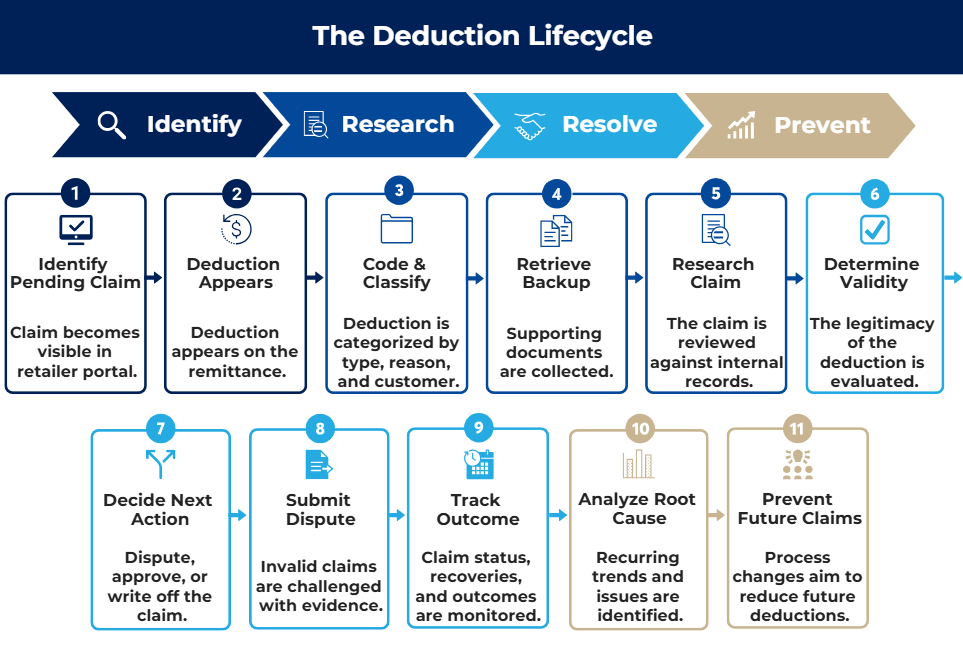
A typical deduction lifecycle may include:

  1. Pending Claim Is Identified: Some retailer portals make claim data available before the deduction appears on the remittance.
  2. Deduction Appears: The deduction appears on the remittance as a separate line item, customer claim, or short-paid invoice.
  3. Deduction Is Coded and Classified: The deduction is categorized during the cash application process by customer, invoice or reference number, claim number, reason code, amount, and deduction type.
  4. Backup Is Retrieved: Documentation is gathered from remittances, portals, ERP systems, shipping records, trade systems, or internal files.
  5. Claim Is Researched: The customer claim is compared against internal records and supporting documentation.
  6. Validity Is Determined: The deduction is classified as valid, invalid, partially valid, duplicate, unsupported, or requiring additional review.
  7. Dispute or Write-Off Decision Is Made: Invalid, duplicate, or unsupported deductions may be disputed. Valid deductions may be cleared or written off in accordance with policy.
  8. Dispute Is Submitted: A dispute package is submitted for invalid claims through the appropriate customer process.
  9. Outcome Is Tracked: Repayments, denials, partial approvals, and follow-up actions are documented.
  10. Root Cause Is Analyzed: Recurring issues are reviewed to identify opportunities for prevention.
  11. Prevention Actions Are Implemented: Process improvements are made to reduce future deductions.
Flowchart titled “The Deduction Lifecycle” illustrating an 11-step deduction management process, from identifying a pending claim and researching its validity to disputing invalid deductions, tracking outcomes, analyzing root causes, and preventing future claims. The steps are grouped into four phases: Identify, Research, Prevent, and Resolve.

Download our free, comprehensive Deduction Management Guide

Enter your email below to access 50+ pages of practical insights, best practices, recovery strategies, technology considerations, KPIs, and checklists for building a more effective deduction management program.

Get Started

Work with our professional, experienced and stable management team to fill your accounts receivable outsourcing needs.