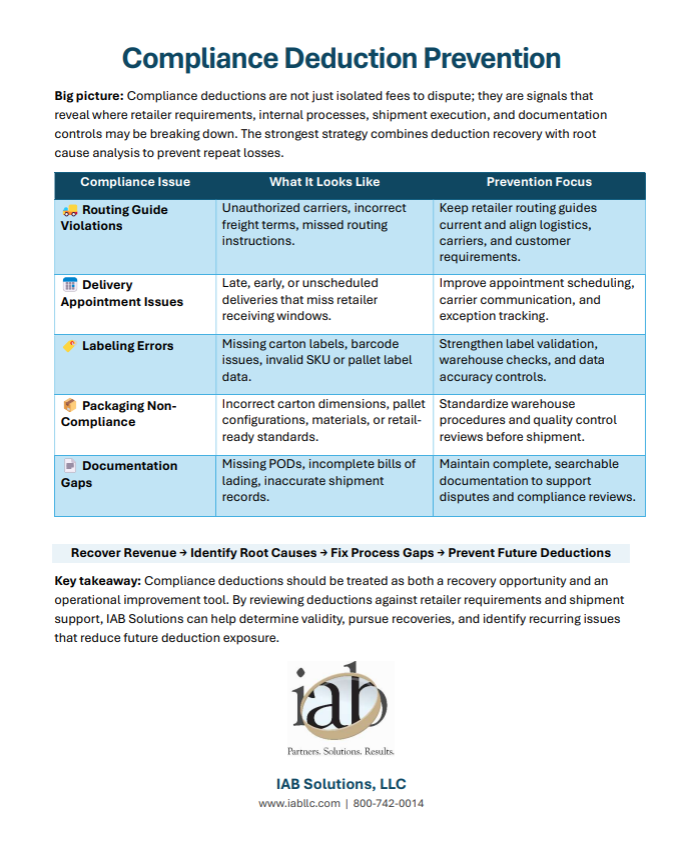
When most companies think about compliance deductions, their first reaction is to determine whether a charge can be disputed. While recovery is important, the bigger opportunity often lies in understanding why the deduction occurred in the first place. The most effective compliance strategies combine deduction recovery with root cause analysis, helping organizations not only recover lost revenue but also prevent future chargebacks.
Why Compliance Deductions Are So Challenging
Unlike many other deduction categories, compliance-related deductions are driven by retailer-specific requirements that can vary significantly from one customer to another. Rules surrounding routing, labeling, packaging, documentation, and delivery are frequently updated and interpreted differently across organizations.
To make matters more difficult, compliance deductions often require input from multiple departments to fully investigate. Logistics, customer service, transportation, sales, and accounts receivable teams may all hold pieces of the information needed to determine whether a deduction is valid. Because gathering and validating that information can be time-consuming, many deductions are accepted or written off without a thorough review.
As a result, invalid or unsupported compliance charges can go unchallenged while operational issues that trigger legitimate deductions continue to recur.
Common Compliance Issues
While compliance deductions can take many forms, most fall into a handful of recurring categories. Understanding where these issues originate can help organizations identify patterns, determine where revenue is being lost, and prioritize opportunities for improvement.
- Routing Guide Violations
One of the most common sources of compliance deductions is failure to follow a retailer’s routing guide requirements.
Examples include:
- Using an unauthorized carrier
- Failing to obtain or follow routing instructions
- Failing to comply with freight terms
- Using an incorrect transportation mode
While these deductions are often treated as transportation issues, they frequently point to process gaps between logistics teams, carriers, and retailer requirements.
- Missed or Non-Compliant Delivery Appointments
Retailers operate highly structured distribution networks that depend on shipments arriving within designated delivery windows.
When deliveries arrive late, early, or without proper appointment scheduling, suppliers may face compliance fines.
Common causes include:
- Transportation delays
- Scheduling errors
- Carrier communication issues
- Changes to retailer receiving requirements
Even when external factors contribute to a missed appointment, retailers may still issue a deduction.
- Labeling Errors
Incorrect or missing labels remain one of the most frequent causes of retailer compliance chargebacks.
Examples include:
- Missing carton labels
- Incorrect SKU information
- Barcode errors
- Invalid GS1 labeling
- Pallet label non-compliance
These issues can slow receiving operations, create inventory inaccuracies, and increase labor requirements for retailers, making them a common target for compliance enforcement.
- Packaging Non-Compliance
Retailers often maintain strict packaging standards designed to improve supply chain efficiency and product handling.
Chargebacks may occur when shipments fail to meet specifications related to:
- Carton dimensions
- Pallet configurations
- Packaging materials
- Product protection requirements
- Retail-ready packaging standards
In many cases, recurring packaging deductions indicate weaknesses in warehouse procedures or quality control processes.
- Documentation Errors and Missing Support
Documentation plays a critical role in both compliance and deduction recovery.
Retailers may issue deductions when required information is missing, incomplete, or incorrectly submitted. Common issues include:
- Missing proof of delivery
- Incomplete bills of lading
- Missing shipment documentation
- Inaccurate shipping records
Documentation gaps can also make it difficult to dispute deductions successfully, even when the supplier has complied with retailer requirements.
What Compliance Deductions Really Reveal
While each deduction may appear to be an isolated incident, recurring compliance deductions often point to larger operational challenges.
These can include:
- Process breakdowns
- System integration issues
- Data quality problems
- Communication gaps between departments
- Inconsistent interpretation of retailer requirements
Companies that focus only on disputing deductions may recover some revenue, but they often miss the opportunity to address the root causes driving future losses.
By analyzing deduction trends and identifying patterns, organizations can reduce deduction volume, improve compliance performance, and strengthen retailer relationships.
How IAB Solutions Helps
At IAB Solutions, we help manufacturers recover revenue from invalid compliance deductions while identifying the operational issues behind them. Our team reviews fines and fees against retailer requirements, shipment data, and supporting documentation to determine validity and pursue recoveries when discrepancies are found.
Beyond recovery, we analyze deduction trends to uncover recurring issues related to routing, delivery performance, labeling, packaging, and documentation, helping organizations reduce future deduction exposure.
Contact IAB Solutions today to learn how we can help recover lost revenue and improve compliance performance.